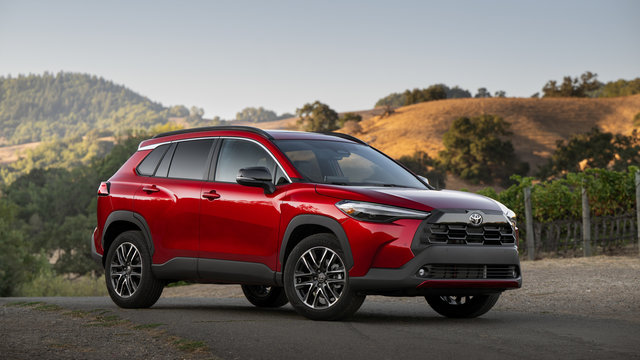
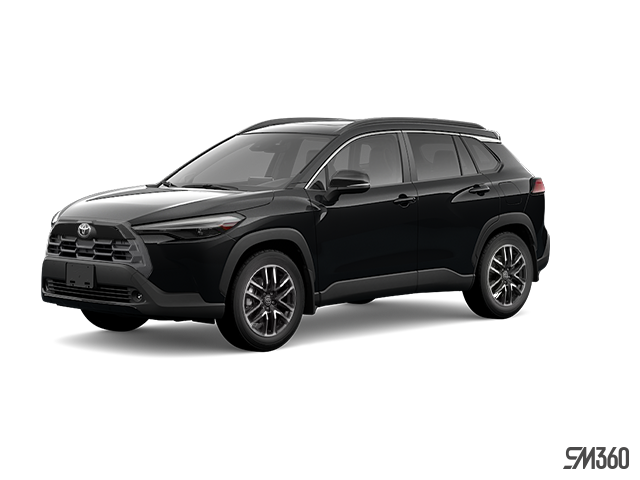
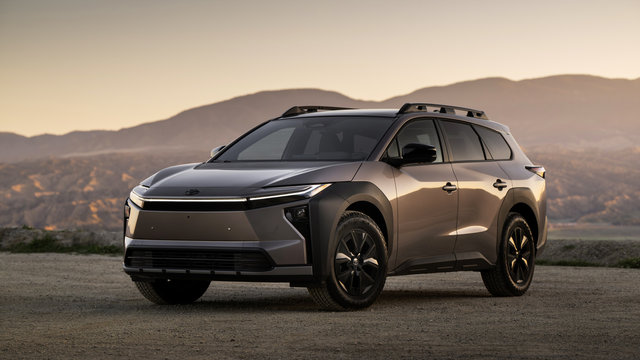
Choosing between the gas and hybrid 2026 Corolla Cross often comes down to one number: how much fuel you burn every week. For Ontario commuters mixing stop-and-go traffic with highway stretches, that number adds up fast over a year. Here’s how the Corolla Cross’s fuel economy ratings translate into real savings, and which powertrain actually fits a daily commute.
Two Ways the Corolla Cross Burns Less Fuel
The 2026 Corolla Cross offers two distinct paths to a lower fuel bill. One is a 2.0-litre four-cylinder gas engine. The other pairs that same displacement with the Toyota Hybrid System and electric motors. Both route power through a continuously variable transmission, but they land on very different combined fuel economy numbers, shown below by drivetrain.
|
Powertrain & Trim
|
Drivetrain
|
Horsepower
|
Combined Fuel Economy
|
|
Gas, L FWD / LE FWD
|
FWD
|
169 hp
|
7.4 L/100km
|
|
Gas, L AWD / LE AWD / XLE AWD
|
AWD
|
169 hp
|
7.8 L/100km
|
|
Hybrid, SE AWD / XSE AWD
|
AWD
|
196 hp
|
5.6 L/100km
|
City Stops vs Highway Stretches: Where Each Powertrain Shines
The gas engine posts 7.6 L/100km in the city and 7.2 L/100km on the highway for FWD trims, or 8.1 city and 7.6 highway for AWD trims, better on the open road than in traffic, typical of a conventional engine working against stop-and-start acceleration. The hybrid flips that pattern: 5.2 L/100km in the city against 6.1 L/100km on the highway.
Its electric motors do their best work at low speeds, so the hybrid’s advantage is largest in the exact stop-and-go driving Ontario commuters see every morning and evening, and it still holds a clear edge over the gas engine once you’re up to highway speed.
How Trim and Drivetrain Choices Change the Numbers
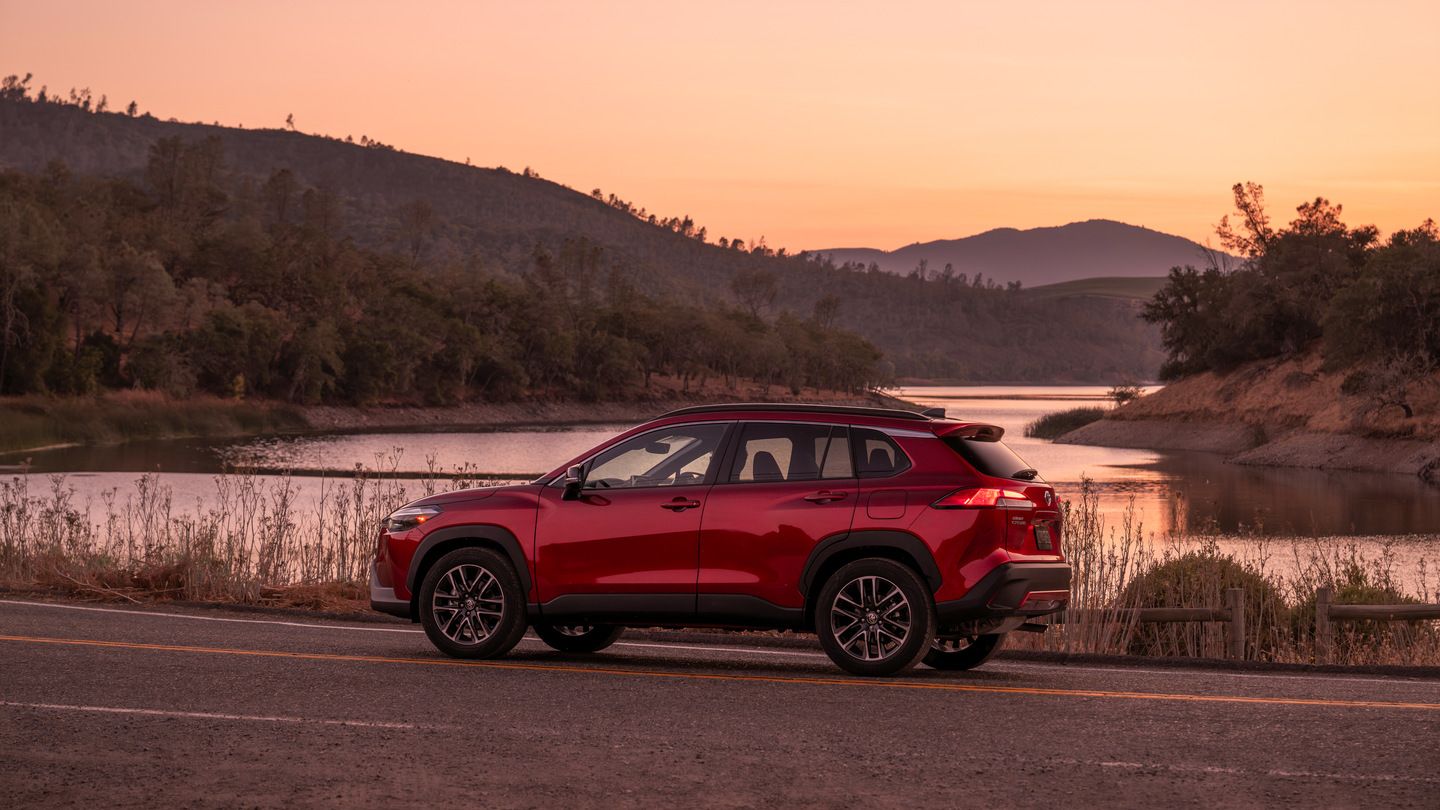
The gas lineup splits between front-wheel drive and AWD. The L and LE trims are offered in either configuration, while the XLE trim comes only with AWD. Both hybrid trims, SE and XSE, come standard with AWD, there’s no front-wheel-drive hybrid on the order sheet.
The gas engine makes 169 hp and 151 lb-ft of torque whether it drives the front wheels or all four. The hybrid system nets 196 hp and 139 lb-ft by adding electric motors, which deliver their torque instantly at low speed rather than relying on peak engine output alone.
Switching a gas Corolla Cross from front-wheel drive to AWD costs 0.4 L/100km in combined fuel economy, rising from 7.4 to 7.8 L/100km, the toll of sending power to all four wheels. Fuel capacity mirrors that split: gas FWD trims carry a 47L tank, gas AWD trims a 50L tank, and both hybrid trims a smaller 40L tank.
Ground clearance dips slightly on the hybrid too, at 203mm versus 208mm on gas AWD trims, a difference unlikely to matter on paved commute routes.
Even with the smaller tank and standard AWD, the hybrid still uses 2.2 fewer litres per 100km than the gas AWD trims. Its electric motors take over the low-speed acceleration that burns the most fuel in stop-and-go traffic, the exact driving a commute is full of.
Why the Combined Rating Is the One That Matters
City and highway numbers only tell half the story. A commute rarely stays on the highway or in traffic the whole way, it’s a mix of both, which is exactly what the combined rating measures. That mix reflects real driving far better than a highway-only figure ever could, especially on a commute that rarely stays in one type of road for long.
That mix matters at the pump. Over every 100km driven, a hybrid SE or XSE AWD trim uses about 28% less fuel than a gas AWD trim, a gap that widens the longer the daily drive. With a 40L tank, the hybrid covers roughly 715 km before refuelling. The larger 50L tank on gas AWD trims covers about 640 km, and the 47L tank on gas FWD trims covers about 635 km.
Fewer stops at the pump over months of commuting add up to real time saved, even with a smaller tank.
Who Gets the Bigger Payback: Gas or Hybrid
The gas Corolla Cross suits a budget-focused, shorter commute. The L and LE trims in front-wheel drive keep cargo space at 680L with the seats folded, more than the 609L available on any AWD trim in the lineup, useful for gear or a weekend cottage run.
High-mileage commuters get the bigger payback from the hybrid SE and XSE AWD trims. Their 196 hp comes with a combined 5.6 L/100km rating, so merging and passing power doesn’t cost extra at the pump. Both hybrid trims add Toyota Safety Sense 3.0, including lane tracing assist, dynamic radar cruise control, and a pre-collision system, useful backup on high-traffic commute routes.
The XSE AWD and gas XLE AWD trims step up to a 12.3-inch digital gauge cluster, versus the 7-inch display on lower trims, an easier read at a glance during a long drive.
Heated front seats come standard from the base L trim through the range, taking some of the fatigue out of a long drive regardless of which engine is under the hood.
Making the Fuel Economy Call on Your Next Corolla Cross
The 2026 Corolla Cross puts a clear choice in front of Ontario commuters: a dependable gas engine, or a hybrid system that uses noticeably less fuel per 100 kilometres without giving up merging power.
Visit Erin Park Toyota in Mississauga to test drive the hybrid Corolla Cross and compare it against the gas trims with our sales team, including a fuel-spend estimate built around your actual commute distance.